Showing posts with label analysis. Show all posts

Tuesday, March 22, 2016

... On Russia's All Female Battalions [day 22]

Welcome to day 22 of our month long project here. Today we're going to dig back into the ugly realm of warfare to take a peek at another battalion of women who you probably wouldn't want to meet on the battlefield. Let's take a look at Russia's "Women's Battalion of Death."


Now if you're like me you're probably surprised that Russia of all places would have female frontline fighters back in WWI. But as I've said before, war makes unusual things happen and an unusual confluence of factors including the abdication of Russia's Tsar at the time led a new government to attempt some pretty radical (for Russia) policies. On top of that a war was going on and Russia's soldiers were NOT doing well. Morale was low and most of the men were sick of this shit! 

Around this time the new head of the country's Minister of War, Alexander (Alexandra in some accounts I'm really not sure which) Krensky devised an idea of creating "shock battalions" to raise the men's spirits. The idea was these would be skilled and disciplined units that existed to galvanize the troops and rally them to fight on with zeal and enthusiasm. I'm not sure how good of an idea this was but leading men in a manner like this is more an art than a science and we're talking about a new, unstable government DESPERATE for ideas. Around this time a woman named Maria Bochkevia. A former peasant turned soldier, Bochkevia thought that an all female battalion, equal to any male regiment would shame the men into greater duty and valor. Basically, she thought to use the "No way am I letting a girl show me up" mentality against the male soldiers. That's right. She planned to use their own sexism as a weapon against them to get off their asses and actually fight. 

Step aside boys. This is a job for the ladies! 


Seemed like a good idea even if she was on some level ripping off the Dahomey Amazons (she probably didn't know and I'm only mostly kidding) and there was some precedent for it. Individual women on rare cases had snuck their way into the Russian military before in defiance of the old laws from before the Tsar's abdication and had a nasty habit of demonstrating bravery, skill and dedication to duty that made their male colleagues feel a bit sheepish. Some of that was probably due to the fact that a lot of the men were conscripts and the women were all clearly volunteers in these matters (score one for volunteer armies). In fact, officers went out of their way to praise the female soldiers they had that they knew about and the women made it a point not to neglect their duties. 

Now all that said, Bochkevia had her work cut out for her in this one. She was battling the inherent sexism of her culture and knew it (though she underestimated the extent of it) and knew she and her recruits had a lot to prove. She harshly punished any traditional expressions of femininity among her recruits including but not limited to giggling, excessive smiling and any behavior dubbed, "flirtatious." Between that and the shaved heads she enforced it was clear she was trying to make sure the women fit in with the Russian ideal of what a soldier was. That meant observing traditionally masculine behaviors and attitudes. Oh did I mention she encouraged swearing, spitting and drinking among her would be soldiers? 

I think Toph is saying that sounds like her kind of women's group!


For all her work though there were still problems. The uniforms they had to work with were generally ill fitting, unmade for women's frames and their equipment (boots particularly) didn't fit right. Furthermore, remember when I said before thta Bochkevia underestimated the sexist response she'd get from the men? Oh lord were the male soldiers on the front not happy at ALL to see the women's battalion. Though skilled in battle and demonstrating great courage under fire, this seemed to only make the men more angry at the new battalion rather than encouraging them to fight and their anger got directed both at the women they deemed unfit for combat, as well as the government they felt was keeping them in the war that, as stated before, they wanted no part of anymore. 

Unfortunatley, when another revoution occurred the women's battalions were disbanded and to make matters worse, many of the soldiers didn't transition back to the non-war world well. Not for lack of trying but the hostility toward them was strong. The shaved heads marked them as being part of the old regime's propaganda attempts and between that and the sexism that many women are attacked with for daring to be something other than what their society deems appropriate many of the women were assaulted and discriminated against after the war though others did stay and fight in other conficts within and outside of Russia. Even so, a complex combination of interwoven factors has kept these women (about 6000 served in these sorts of units) out of history and it is a shame because you can't learn from a history that's not discussed and you can't apply the lessons. That said, Russia didn't forget about the idea entirely and today some of this idea can still be seen in the fact that their elite special forces, the Spetnaz, have incorporated women and co-ed units for some time now.


There's a lot of stuff to unpack with the stories of units like this. All kinds of complex issues from the presence of toxic masculinity to the politics of using women as propaganda props to the concept of performative masculinity and femininity as well as the cultural design of gender roles. All of these are topics which are perhaps a bit heavy for this space and things that I'm admittedly not well versed enough to speak on. As such I'll tell you to go out and seek knowledge yourself if it's something your interested in. Google is your friend. And with that I end things for the day. We've dealt with a lot of figures from numerous fields... but I realize we haven't touched on any visual artists since that initial blast of mini-profiles at the start of the month. Tomorrow let's remedy that. 


Saturday, July 4, 2015

...On Moses from Liberty's Kids

Today is the 4th of July, also known as Independence day in the United states, and like most people I know I'm sitting at home and playing a rousing rendition of "Firework or Gunshot!"

Pictured: An accurate representation of my face with each explosion outside

Beyond the discomfort presented by the cacophony of barely controlled explosions in the world beyond my walls I find the weight of history and my own awareness of it bearing down upon my mind and twisting my emotions in ways both painful and cantankerous today. This day has not been one of unadulterated celebration for me since I was a child and spared from the sobering understanding that this holiday, this "Independence Day" was not in its inception or its character, meant for me. I suspect that I've struggled with this truism for some time whether I was cognizant of it or not. For many years I just saw this as another day in the year, rather than battle with the intense melancholy the day brought about, and yet today the full force of the aforementioned truism is inescapable.

Current events have exacerbated this truth for me by orders of magnitude unfathomed, and this meditation on the interwoven knots of fact and fiction associated with this day has only had its difficulty enhanced.

And through all of this a single character has been running through my mind today. A character by the name of Moses.

No, not the Moses of the Bible or the Ten Commandments but Moses from the PBS show, Liberty's Kids. 

"I am a free man–in the employ of Benjamin Franklin"

Liberty's Kids was a show that took a rather unflinching look at the American Revolution and for a kids' show it did a number of things that still amaze me to this day. While not perfect, it examined the plight of the Native Americans in the war effort, examined the merits of both sides of the revolution (the colonists and the loyalists) and most pertinent to this post, didn't shy away from the issue of slavery, nor the uncomfortable truth of many of the founding fathers as slave owners. At the center of a great deal of this unflinching take... was a former slave and self taught engineer by the name of Moses.

As a young man Moses may have been one of my favorite characters I'd ever seen. In many ways, he was the first black man in fiction who behaved in a manner worthy of the black men I knew personally, rather than the stereotypes oft presented to the masses for consumption, especially in historical fiction. A former slave, brought in chains from West Africa to the United States he taught himself to read and write, and became a blacksmith of considerable skill. It was with that skill he purchased his own freedom and in that I have always seen an example of Liberty's kids forthrightness and power. Moses was not "rescued" from slavery. As a kids show, this would have been an easy route to follow. Moses and the leading child characters were fiction. Fabrications purely for the needs of the show and as such any number of watered down narratives could have been used for Moses, including the white savior narrative so commonly trotted out as a way to do a "not all white people" lesson to help the audience not feel so bad about Moses' plight.

Instead they chose a backstory where Moses' freedom was not granted to him, but rather he seized it for himself and that boldness shined through in Moses consistently.

 Moses was kind, compassionate and wise as a caretaker for the main characters. Yet far from being the safe and neutered "Magical Negro" trope often seen in fiction where the black character only serves to pass folksy wisdom to the white characters, Moses had a will as sturdy as the metal he taught himself to shape. Though there was only so much he could get away with (the show takes place in the 18th century and is trying to be as accurate as it can be within the bounds of a children's show) he was still righteously intimidating when he had to be and had to fight and scrape for every ounce of respect he ever had. Even in a time when the white supremacy of the U.S. was so formidable, and people would attempt to intimidate the man, Moses refused to cede his ground.

More than once Moses would show his freedom papers, to another character and declare with great solemnity and pride "I am a free man–in the employ of Benjamin Franklin," and though had he been an actual figure in history, it is his employer who would likely have been his greatest protection from the injustices of his age, the pride in the voice actor's delivery at the line, "I am a free man" is always what was emphasized.

The most memorable and powerful line that cemented Moses' place as a character of unmatched strength and intensity was in a scene where he confronted a man in support of the institution of slavery. Moses, who towers over the other man and tells him in no uncertain terms...

"You are entitled to your opinion sir... just know that in its exercise, you would deny me mine!"

He manages this feat with a combination of dignity and barely suppressed rage I have rarely seen since and never in a children's show.


And so today I consider Moses. I consider how a fictional character, living in the 1700's manages to be so relevant to me today in the wake of the horrors of current events that swirl like the most turbulent of waters all around my life. Today I consider a man that had he actually lived, would have seen the signing of the Declaration of Independence for which we celebrate today, and would have to recognize that he was still not truly free. I think about the actual freedmen and women of the day who would likely look at their papers and have to wrangle the cognitive dissonance of knowing that a man heralded as one of the greatest of his age, a man who wrote: "We hold these truths to be self evident, that all men are created equal..." could write those words as a slave owner.

Like I imagine many a person of color before me has done and I know many are doing today, I wrestle ardently with the bones of this dissonance. I struggle with the fact that today celebrates the independence of a nation from what they considered cruel tyranny and yet in turn would have kept my ancestors as beasts of burden for its use in ways too gruesome to contemplate for long. And though the sting of knowing that history has been dulled by learning the lesson countless times, the matters of the present day make it clear that the idea of some, that we had banished racism to the four winds, is a delusion both entrenched and dangerous in the extreme.  My nation's racism is not a skeleton, long dead and rotting. How can it be when in my own life I have known men and women who saw the tail end of segregation with their own eyes?

How can it be when I have had teachers and colleagues across the spectrum who attended the civil rights marches of the 1960s?

How can it be when my own mother, as a young girl in Mississippi, was not allowed to read the books she desired because they weren't in her section and as a young adult was chased from a party at which she was the only black attendee by the site of a burning cross on the yard?

So I think about Moses and by extension the real freemen and women whom his story stands as representative for. I am once again drawn to a cartoon character from one of the most unflinching shows for kids about history I've ever seen. It didn't shy away from the ugly truths of the founding fathers of this nation as slave owners, not did it pretend that life was easy for black folks once they were off the plantation whether they were in the south OR the north (much of the show's bits with Moses take place in Pennsylvania).

And in the end I think about a simple fact: we have come a long way in this country... but when one considers the issues still before us, one and all, and the terror that still seeps deep into the bones of me and those like me, for whom, due to the color of our skin, this world was not built for us, this country has a long way to go before it can live up to the truth of its ideals, rather than the mere sentiment. It's what's owed to the real men and women who's stories Moses represents.

Saturday, June 20, 2015

...On the Discussion of Feminism in Mad Max: Fury Road

Note: Originally, this was hosted on my Facebook page (which is invite only. Sorry folks. ;) ) However, since it's partially made me want to do this, I felt it only fair to share it here and do a little something special with it (since you can't really get pictures in a note on Facebook the way I want them.)

Disclaimer: The following is an opinion-based analysis ofthe discussion around Mad Max: Fury Road. The views expressed are mine and mine alone. I am not an expert nor have significant experience on film critique,feminist theory, general internet drama or any other subject unless I explicitly state as much and the following think piece is not intended as a value judgment on any other opinion relating to the movie or as trying to convince anyone of the correctness of my ideas or point.

Alright, all that out of the way...


Recently the internet did what it does best and got very excited over relative triviality: namely the release of Mad Max: Fury Road. More specifically, the internet community got excited over a laughably easy to lampoon diatribe from “Men’s Rights activists” claiming the movie was covert feminist propaganda. I personally like to imagine they looked something like this while spouting their nonsense...


Though admittedly babies might find being likened to MRA's in any way sort of insulting.
Babies do at least have SOME measure of class.
In a move that I’m sure actually did more to help the movie sell tickets than hurt, the crazies boycotted the film but got more people curious and provided more free advertising the studios could have dreamed up as a number of people went to see it just to spite them. But mostly because people were scoffing. This was freakin' Mad Max after all. This franchise was supposedly the ultimate guy movie. Explosions, fast crazy muscle cars, guns, more explosions, badass fight scenes and did I mention explosions? The testosterone was supposed to be so thick in the air of a Mad Max movie you could cut it with a knife and mere exposure to the film would make your testes drop. Nobody went in thinking much of the film on opening weekend I think. 

But ya know what? Turns out that even a stopped watch manages to tell the correct time twice a day and this time the trolls under the bridge may have had a point. Other than the one protruding from their sloped foreheads. The movie’s feminist bona-fides ended up being touted all over the place from lots of different groups.

Still, others were more skeptical and made the argument that a feminist film should be more than what we get out of Fury Road.

After finally getting to see the film myself… I can see quite clearly as to why.

Both sides make astoundingly valid points but the internet has this problem where it doesn’t handle nuance well and people think too often that can’t happen. That there is only right or wrong.

Before I delve into the meat of this let me make clear this is not a review of the movie but if you want my take: It’s a competently done action movie and a greatride but this was NOT a movie aimed at me. The high-octane world of car culture and car movies isn’t anywhere I’ve ever felt comfortable and contrary to popular belief it is possible to recognize a movie is well made and not enjoy it much. Beyond that, the feminist ideas in the movie (and yes there are unequivocally feminist IDEAS here) were about all that kept me engaged. That said it’s all stuff as far as feminism goes that I’ve already internalized so I’m doubly not the audience because there are some people who needed to hear what this movie is trying to teach. But as I’m about to elaborate on I’m not sure they end up being applied in the best way possible

Warning: I’m about to spoil pretty much EVERYTHING. 

The Feminist Argument

When people make the claim as to the feminism of Fury Road they admittedly have a lot to work with. The movie is not at all subtle in its desire to be a feminist action flick. The movie sets up its depiction of a harsh patriarchal world quickly with a number of powerfulscenes including one where women are hooked up to milking machines and exploited like cattle while another scene reveals the young men of the villain Immortan Joe’s military force known as War Boys feel utterly useless if they cannot go to war for a despicable old man promising them that if they die in battle they’ll be rewarded richly in the afterlife. All of this pales in comparison however, to the opening scene in which it’s revealed that Joe keeps the people he commands under his control by controlling the water supply and even telling them “do not become addicted to water.” Let that sink in a moment. Moving on, the film’s action is kicked off by the discovery Furiosa, Joe’s main general has absconded with a group of women he calls his “breeders.” The rooms of the enclosure in which these women were kept are scrawled with phrases like, “who killed the world?” and “we are not things.” The camera pans down to the floorwhere Joe sees “our babies will not grow up to be warlords.” 

Like I said, subtle this movie is not.

Pretty much the only tool it knows how to use.

The movie then becomes one long elaborate chase scene with Furiosa trying to get herself and the rescued women to safety with Max aiding but mostly along for the ride. Though the ‘wives’ are dressed rather skimpily through the film they’re never really sexualized in the way they would be in other action movies of this type. Much has been made of what’s been dubbed the,‘Max lusts for water, not women’ scene and the movie keeps away from the male gaze for the most part–though in the scene in question I wonder if the camera guy was following orders properly sometimes–and keeps an almost laser focus on the women’s faces in the film. 

That may not seem like a big deal but in a medium that pretty much codified the idea of the male gaze I assure you that kind of conspicuous focus is saying something. 

The survivors–the movie calls them Joe’s wives but other articles have called them what they in fact are in the story’s narrative and I will too: rape survivors–are not warriors but nor are they damsels in distress. Yes, they rely on Max and the much lauded badassery of Furiosa to survive and don’t really assert much in the way of separate character traits or personality, but nor are they the burdens they’d be in a lesser film. They don’t even flinch to help Furiosa in a fight against Max when they first meet, they’re not stupid and each pulls their weight in their own ways with one survivor, Splendid, even going so far as shield the others with her pregnant belly to assure Joe can’t take a shot that would have killed Furiosa (because he desperately wants the baby inside of her). They are different, but they are not less. They all contribute, which, if one understands feminism as the idea that women and men are inherently equal and should both be able to shape their destiny according to their own will without prescribed roles, is depicted rather gloriously.

The movie also takes aim at patriarchy itself in the cartoonish exaggerations of the villains. My girlfriend and I had a long conversation about what the three old, white, male leaders of the various towns represented in the grand scheme with us agreeing Joe represens the conflation of war and religion, the leader of Gas Town representing capitalistic greed and the leader of the Bullet Farm representing the dangers of gun culture and unrestrained violence. We’re expected to see these men as what they are: exploitative of women, who they see only as objectsof sexual satisfaction and for breeding, and also of other men for labor, the waging of war and aiding in the oppression of others. It’s more than a little telling that the War Boys are brainwashed to the point that they’re suicidally stupid and engage in ludicrously dangerous behavior in an attempt to go to ‘Valhalla.’ The movie makes no attempt to hide its disdain for that which Joe and the villains in this movie stand. A woman by the name of Rebecca Cohen notes here that “Our babies will not grow up to be warlords” demonstrates the desire of the survivors to be free of the power structure that “killed the world,” and break it for their children.

Pictured: The physical manifestation of a misogynist's soul

Then there’s the partnership between Furiosa and Max; probably the crux of the film as feminist masterpiece argument. They value each other’s skills and recognize where each is most useful. Nobody is inherently smarter or more badass than the other. Again, different but not less. 

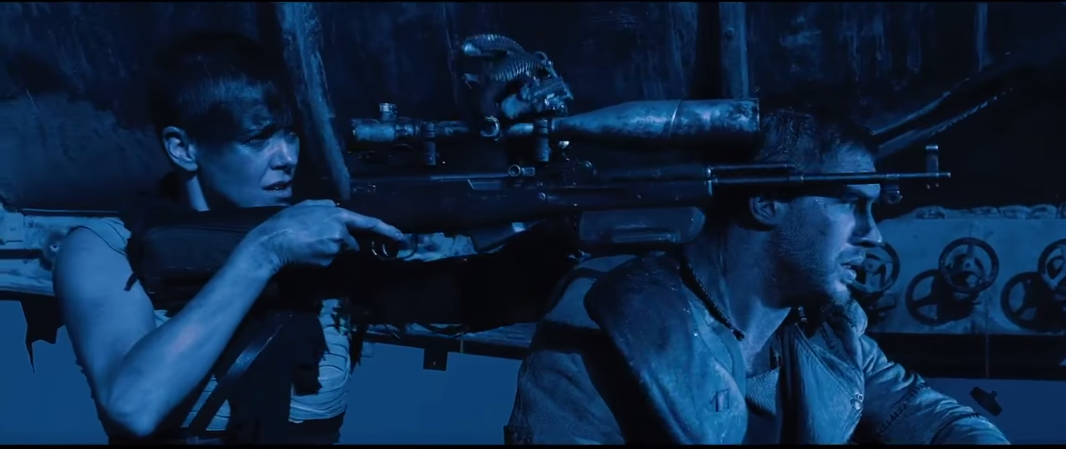
In one of the most symbolically powerful moments in the flick; low on ammo and with villains approaching rapidly,Max takes two of their three shots and misses. Remembering that Furiosa is a master sniper, he hands her the gun, recognizing that she has a greater chance of success than he and prioritizes survival, even going so far as lending his shoulder to be Furiosa’s rifle stand. It’s a powerful metaphor about teamwork and lending what skills we each possess to the cause.

Teamwork. It's a beautiful thing
Then there’s the story of Nux, one of Joe’s brainwashed War Boys who’s arc frankly deserves a piece all to itself in my opinion and he may very well get one before this desire to write is burned out of me.

The counter argument

It might be a bit disingenuous to boil the entire critique of the side that isn’t sold on this being a feminist masterpiece to this single image... 

Sometimes a guitar is just a guitar. Other times... 


But it’s certainly not helping the other side's case! 

Some of those who argue the movie falls short of being truly feminist make the point that our society still equates strength and power with awesomeness and links those things with maleness almost exclusively. It goes out of its way to make the crazy warparties look cool. The film feels like the epitome of cool as defined by a fourteen year old boy’s brain.

By this logic one could argue that Furiosa is, intentionally or not, coded male. She’s relatively stoic save for a single moment of profound and utter anguish, hyper competent at dishing out violence and her short cropped hair and attire all downplay her femininity in favor ofher more masculine tropes. While this isn’t inherently bad in the least, it becomes worrisome if it’s seen as the ONLY way to make a woman badass is to make her “manly” for whatever value you put on that term. Furthermore this side of the argument goes on to make the point that the movie is rather uncritical of the violence throughout its run noting it to be largely violent spectacle that even with the answer to the question “who killed the world” asked repeatedly being men and the hyper aggressive militant patriarchy, the movie still resorts to violence to eliminate the problem. 

If I understand correctly, this side argues that there has to be a better way. They argue that feminism advocates not for women to be allowed to engage in the same violent, exploitative system men do, but to find a better path; one that recognizes the equality and dignity of all. They claim the Fury Road fails to provide adequate critique when it has the heroes solve their problem by simply lobbing the same violence at the villains. 

My thoughts


I do take some issues with what I currently understand the movie’s detractors points to be. The issues of violence strike me as odd partially because there’s an argument to be made that violence is inherently human, rather than gendered. I’ve trained with many women more than capable of dishing out plenty of damage and while violence is pretty much the favorite tool of patriarchal oppression, that doesn’t mean men have a monopoly on it. In fact in more than one species, the female is much more deadly than the male. Furthermore sometimes making the highly violent, sociopathic people the villains is enough of a critique itself. If you can’t see the villains as having some pretty distorted decision making processes, that might be a problem with the viewer, not the movie. 

Beyond that, violence as a tool of self-defense and of revolution is also tied almost intrinsically to human history and when all else fails I see nothing wrong with protecting oneself from destruction with violence. Even the women’s suffrage movement sometimes used tactics that weren’t exactly non-violent protest so it’s not like feminism is above violently throwing off oppression. And I’d argue there really wasn’t much of a different choice in the world we’re given in the film for the women to make. It’s not like the three war parties were particularly apt to listen to reason. They weren’t likely to be defeated with a stern talking to.

Even with all the violence in the movie and the women engaged in that violence I feel like some of the critiques of the film that call its feminism into question ignore the fact that the final decision in the movie’s climax to turn back and fight their pursuers isn’t made by Furiosa, the Vuvalini, or the survivors; it’s made by Max. He’s the one who makes the suggestion to fight. That’s the last thing the women want. They didn’t want to engage and that theme flows through the whole flick. Furiosa’s initial plan is to run from the citadel (under the guise of something she'd be doing anyway), eventually lose the War Boys who were sent out with her somehow, seal off the road behind her and book herself and the survivors into the safety of her tribe. She only engaged in violence when she couldn’t come up with anything better and originally, after meeting up with her old tribe, the women wanted to load up their supplies and keep running. 

Admittedly, that wouldn’t have made for as much of a satisfying ending though.

If I examine my own inclinations and beliefs I can’t be perfectly on board with the idea that this movie is not feminist. It desperately wants to be and it believes in the inherent equality of the sexes earnestly.

And yet I also can’t be entirely onboard with those who believe this is a feminist masterpiece. I do in fact, believe that part of feminism is and should be finding another way rather than lobbing the weapons of oppressive patriarchy back at it. So I find myself stuck. Unwilling to side with the detractors but also, being unwilling to call this film – which is a great action movie, a powerful story and apparently fora lot of folks, a ton of fun – truly feminist.

Here’s the thing though, I’m not sure how much that matters. I like to consider myself a feminist and ally but I’m not trained in feminist theory and most of my knowledge is second hand from women I’ve listened to describe their experiences and ideas, or instinctive from growing up in a home full of intelligent, wise, strong and capable women. That however, does not provide me any unique perspective. I don’t get to be some arbiter of what is or isn’t truly feminist.

What I will say is that even if you’re not willing to call the movie truly feminist, I think the one thing that everyone can agree on is that the film is extremely ANTI-PATRIARCHY. After all, the film knows EXACTLY and without question who brought the apocalypse and killed the world.

Alright guys, that was fun. Definitely going to do this again. Hope to see you when I do.